
Research
We focus on the discovery of quantum materials and build new tools to synthesize them. We are especially interested in single crystal growth, and work hard to produce large, high-quality crystals in order to perform complex measurements of electronic and magnetic properties. We perform these measurements at home, over a wide range of temperatures and magnetic fields, and at scattering facilities in the United States and abroad, where we use X-rays, neutrons, and muons to probe their structure and electronic behavior.
Autonomous crystal growth: AutoFlux
Flux crystal growth is opaque. The crucible hides the entire process, so the first look at any growth comes only after it has ended, and a failed run returns almost no information. Outcomes hinge on experience and intuition, growths are hard to reproduce between laboratories, and the primary literature records recipes, not processes.
AutoFlux is our answer: a platform, built in our dedicated growth laboratory, that images flux growth inside the furnace as it happens and uses those images to act on the growth in real time. The long-term vision is to close the loop between observation and control, so that flux growth becomes reproducible, documentable, and ultimately learnable by machines as well as people. The work is supported by the National Science Foundation.
Frustrated quantum magnetism
In crystallographic networks built from triangular and tetrahedral motifs, atoms that carry magnetic moments cannot settle into a long-range ordered state in which every moment has an energetically favorable interaction with all of its neighbors. In transition metal compounds these moments usually come entirely from the spin of the electron, because the orbital contribution is quenched by strong electrostatic effects, that is, by the crystal field. We are especially interested in compounds where, for one reason or another, the orbital contribution is not fully quenched, so that both spin and orbital degrees of freedom may remain fluctuating and give rise to an elusive state known as a quantum spin-orbital liquid. We synthesize candidate materials as powders and single crystals, and we study their magnetism with magnetometry and heat capacity, their structure with neutron and synchrotron diffraction, and their dynamics with muon spin rotation and inelastic neutron scattering.
Superconductivity and competing orders
Superconductivity rarely appears alone. In the materials we care about it emerges next to magnetism, charge or orbital order, or a metal-to-insulator transition, and small changes in composition or structure can tip the balance between these competing states. We are especially interested in families of compounds with sufficient structural similarity between members to allow for well-ordered and controllable chemical substitution and modification, allowing tuning between, for example, a charge-ordered insulator to a metal and onward toward a superconductor. Which state wins is set by the competition between energy scales: the interactions among the spin, charge, and orbital degrees of freedom of the electrons, their coupling to the lattice, and the bandwidth that lets them move, and chemical substitution shifts each of these scales by a controlled amount. We synthesize these materials as powders and single crystals, tune them by chemical substitution, map their phase diagrams with resistivity, magnetization, and heat capacity, and resolve the structural distortions at each transition with neutron and synchrotron diffraction.
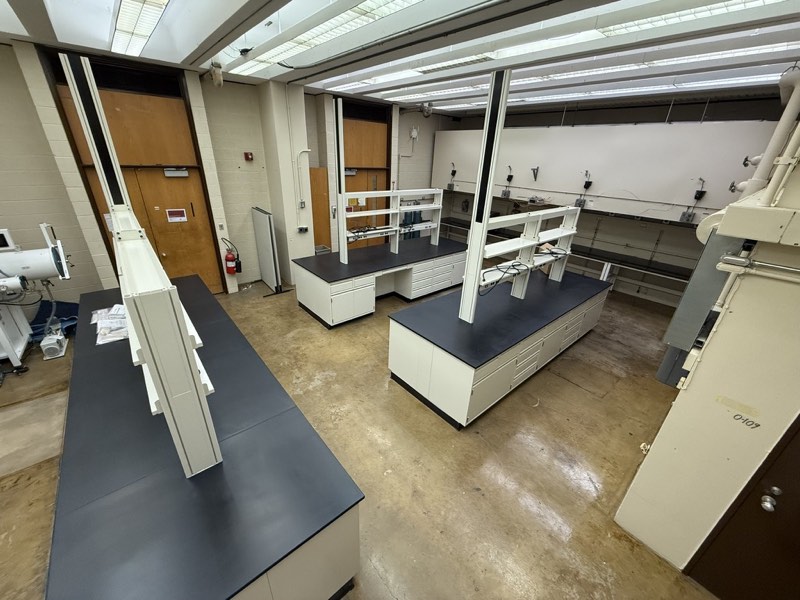
Our home is in Wean Hall at Carnegie Mellon University: a synthesis laboratory with a glovebox, furnaces, and a tube-sealing station; a dedicated growth laboratory for AutoFlux; and a 14 T Quantum Design PPMS DynaCool for electrical, thermal, and magnetic measurements down to 1.8 K.
For X-rays, neutrons, and muons we travel, and we collaborate with scientists around the world. The map shows the facilities on three continents where the group runs experiments.
- APS: Advanced Photon Source, Argonne National Laboratory, Lemont, Illinois
- BNL: Brookhaven National Laboratory, Upton, New York
- NIST: NIST Center for Neutron Research, Gaithersburg, Maryland
- ORNL: Spallation Neutron Source and High Flux Isotope Reactor, Oak Ridge National Laboratory, Oak Ridge, Tennessee
- NHMFL: National High Magnetic Field Laboratory, Tallahassee, Florida
- LANL: Los Alamos National Laboratory, Los Alamos, New Mexico
- LLNL: Lawrence Livermore National Laboratory, Livermore, California
- CLS: Canadian Light Source, Saskatoon, Saskatchewan
- TRIUMF: TRIUMF, Vancouver, British Columbia
- ISIS and Diamond: ISIS Neutron and Muon Source and Diamond Light Source, Harwell, United Kingdom
- ILL: Institut Laue-Langevin, Grenoble, France
- PSI: Paul Scherrer Institute, Villigen, Switzerland
- DESY: Deutsches Elektronen-Synchrotron, Hamburg, Germany
- BESSY II: Helmholtz-Zentrum Berlin, Berlin, Germany
- J-PARC and JRR-3: Japan Proton Accelerator Research Complex and the JRR-3 research reactor, Tokai, Japan